Preclinical research
Paper published 2026-03-23The question: killing requires arriving
A cancer-killing immune cell has to reach its target before its killing machinery matters. That physical requirement is especially demanding in solid tumors, where immune cells must leave the circulation, cross tissue boundaries and enter an abnormal local environment. A 2026 study led by Stanford geneticist Livnat Jerby asks whether cell engineering can improve that navigation step by teaching immune cells to follow small molecules associated with cancer metabolism.
The idea adds a different task to the familiar job of antigen recognition. A chimeric antigen receptor, or CAR, helps an immune cell recognize a molecular feature on another cell. A navigation receptor can instead help it reach the neighborhood where recognition should occur. These functions are complementary: better targeting after contact cannot by itself solve a failure to enter the tumor.
From patient data to a functional screen
The team began with existing single-cell RNA measurements from paired breast tumors and blood, alongside a larger atlas of natural killer cells across cancer types. Genes enriched in tumor-resident immune cells supplied candidates for a functional test. Expression patterns alone would have been ambiguous: cells might switch on a gene after arriving, rather than need it to arrive. The next step therefore deliberately increased candidate gene activity and measured the consequences.
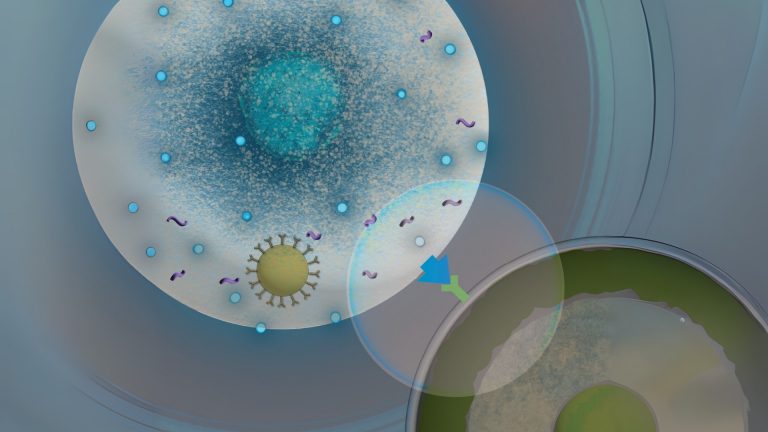
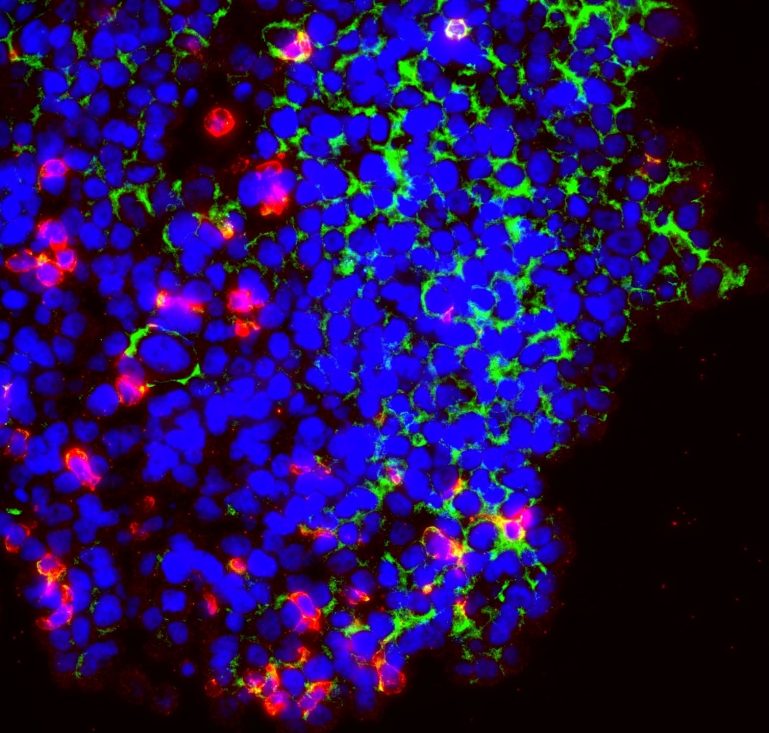
Using CRISPR activation in the human NK-92 natural killer cell line, the researchers screened for cells recovered from breast and ovarian tumor models. Comparisons with cells in other compartments helped distinguish tumor enrichment from simple persistence after transfer. Follow-up migration assays and tumor spheroids tested whether the selected changes also helped cells respond to substances released by cancer cells outside a whole animal.
A second layer of cell engineering
Several promising genes encoded G-protein-coupled receptors, including receptors for bioactive lipids. The team studied GPR183 particularly closely. Its known ligands include oxidized cholesterol derivatives, linking altered tumor metabolism to a signal an engineered immune cell can use for movement. This shifts the engineering question from which surface antigen a tumor displays to which chemical cues the surrounding tissue makes available.
Adding GPR183 improved tumor infiltration and control in experiments with NK cells, CAR-equipped NK cells and CAR-T cells. The investigators also tested engineered mouse T cells in animals with an intact immune system. Together, these experiments support a mechanism in which sensing the local biochemical environment can strengthen an otherwise tumor-reactive cell therapy. They do not establish that every metabolically active cancer will supply a useful or exclusive navigation trail.
What the models leave unresolved
Important limits concern both the models and the chemistry. The screening platform began with an immortalized NK cell line, and several experiments used human cancers implanted in immunodeficient mice. Such systems cannot reproduce the full competition, inflammation and tissue organization present in patients. Testing another cell type or tumor can change whether a receptor improves delivery, survival or both.
The paper also notes that direct measurement of some GPR183 ligands is technically difficult because their abundance is low relative to cholesterol and analytical signals can overlap. Functional migration assays provide evidence that a receptor detects a useful cue, but leave open the possibility of additional ligands or cooperation with other receptors. Normal inflamed tissues may produce related signals, making distribution beyond the tumor an essential future safety question.
The next experiment
A persuasive next stage would compare receptor-equipped and conventional therapeutic cells across multiple patient-derived tumors while measuring where both populations accumulate throughout the body. Pairing those measurements with local metabolite analysis could identify which cancers are most suitable. The broader lesson is that cell therapy can be designed around movement as well as recognition: the geography of an immune response is part of its biology.
Key terms
- Chemotaxis
- Directed movement along a chemical concentration gradient.
- CRISPR activation
- A method that increases the activity of selected genes without cutting them out.
- GPR183
- A cell-surface receptor that can detect oxidized cholesterol molecules.
Original publication
Kim, Y.-M. et al. Engineering NK and T cells with metabolite-sensing receptors to target solid tumors. Nature Immunology 27, 1039–1052 (2026).
March 23, 2026
Read the paper · DOI 10.1038/s41590-026-02473-y ↗Stanford research coverage ↗
Sources reviewed & Stanford connection
Primary paper abstract, main results and discussion read; official Stanford coverage checked. No clinical efficacy demonstrated.
Young-Min Kim and Livnat Jerby; Stanford Department of Genetics and Stanford Cancer Institute.
This is an original explanatory article about the cited study. It is not a new paper or Stanford-authored news report.