Preclinical research
Paper published 2025-06-10The question: engineering without cell collection
Conventional CAR-T therapy involves collecting a patient’s immune cells, modifying them outside the body and returning them as a manufactured cell product. A Stanford-led study asks whether a different workflow is possible: deliver temporary molecular instructions to T cells already inside the body, then measure whether the newly engineered cells reach a tumor. The work joins two problems often studied separately—making a therapeutic cell and finding out where it goes.
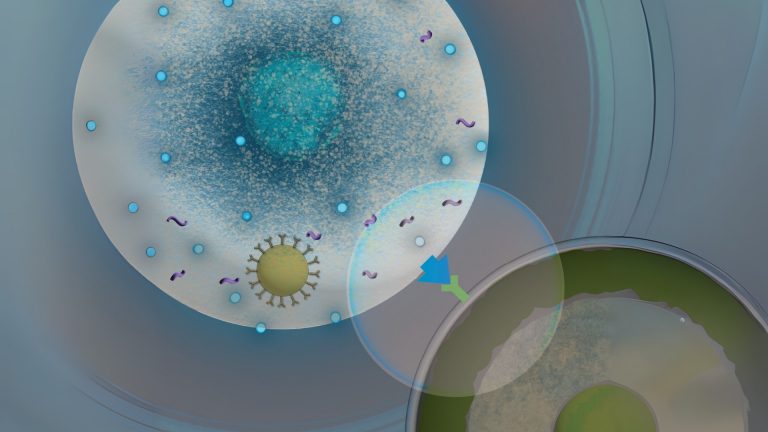
The study was led by Nisi Zhang and Katherine Ferrara with collaborators including Stanford oncologist Ronald Levy. It used a mouse B-cell lymphoma system, not a patient trial. The researchers packaged messenger RNA in lipid nanoparticles and attached an antibody directed at CD5, a surface protein found primarily on T cells. This targeting step was intended to favor the desired immune-cell recipients over other cells that might absorb the particles.
A therapeutic message and an imaging tag
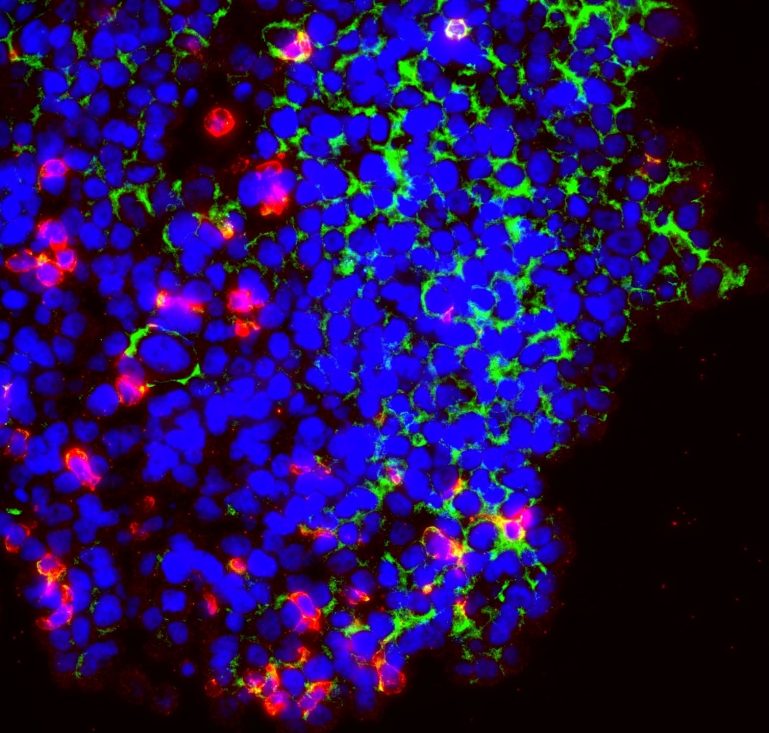
One RNA message encoded a CD19-directed CAR, allowing a recipient cell to recognize a marker carried by the lymphoma model. Another encoded a modified PSMA imaging tag. The tag created a binding site for a PET tracer, providing a noninvasive readout after the cells translated the delivered messages. Optical reporters supplied an additional experimental tracking method during protocol development.
This design gives imaging a specific biological meaning: a detectable tracer signal can help locate cells expressing the reporter. It does not automatically prove that every tagged cell is an equally effective cancer killer. The investigators therefore combined imaging with flow cytometry, tissue analysis and tumor measurements. Those complementary assays connected the delivery readout to cellular identity, location and antitumor activity.
Using measurements to shape treatment
The protocol included interleukin-7 preconditioning and repeated nanoparticle administration. Early measurements placed much of the engineering activity in lymphoid organs such as the spleen. After additional dosing, the researchers detected engineered cells within tumors. Comparing CD5-targeted particles with control formulations helped distinguish the contribution of targeting from nonspecific particle uptake, including uptake in the liver.
The temporary nature of mRNA shaped the dosing strategy. Repeated administration replenished instructions rather than assuming a single delivery would establish permanent CAR expression. Cytokine measurements and imaging helped the team select treatment timing and assess distribution. This is a useful example of an experiment in which measurement informs the protocol itself, rather than serving only as a final illustration that treatment occurred.
How to interpret the outcome
In a repeated-treatment efficacy experiment, six of eight mice in the targeted CAR-mRNA group achieved tumor-free survival. That is an observation in a small, defined animal cohort, not an estimated response rate for people with lymphoma. The researchers reported no detected toxicity under the studied conditions, including repeated dosing, but those measurements cannot establish the full human safety profile or rule out rarer harms.
Several questions remain. Human delivery efficiency, tissue distribution and immune responses to repeated treatment may differ from those of mice. The study assessed only a limited set of exhaustion-associated markers; the authors call for broader markers and functional assays to characterize long-term cell fitness. A reporter can support treatment monitoring, but clinical use would also require validated relationships between imaging signal, cell function and meaningful patient outcomes.
What translation would require
The strongest conclusion is a preclinical demonstration of a coordinated delivery-and-monitoring system. Before a comparable treatment could become routine, investigators would need to establish manufacturing consistency, suitable doses, off-target effects and durable benefit in appropriate clinical studies. The deeper research opportunity is to make cell therapy observable: treatment design becomes more informative when it measures whether the intended cells were generated and whether they reached the intended tissue.
Key terms
- Lipid nanoparticle
- A small lipid-based carrier used to deliver molecular cargo into cells.
- In situ engineering
- Changing cells where they already are in the body.
- Reporter tag
- An added molecular marker used to detect a biological process.
- PET
- An imaging method that detects a radioactive tracer in living tissue.
Original publication
Zhang, N. et al. Development of an in situ CAR-T cell protocol through optical and PSMA-targeted PET imaging. Proceedings of the National Academy of Sciences 122, e2504950122 (2025).
June 10, 2025
Read the paper · DOI 10.1073/pnas.2504950122 ↗Stanford research coverage ↗
Sources reviewed & Stanford connection
Primary paper abstract, main results and discussion read; official Stanford coverage checked. No clinical efficacy demonstrated.
Nisi Zhang, Katherine W. Ferrara and Ronald Levy; Stanford Radiology, Molecular Imaging Program and oncology.
This is an original explanatory article about the cited study. It is not a new paper or Stanford-authored news report.