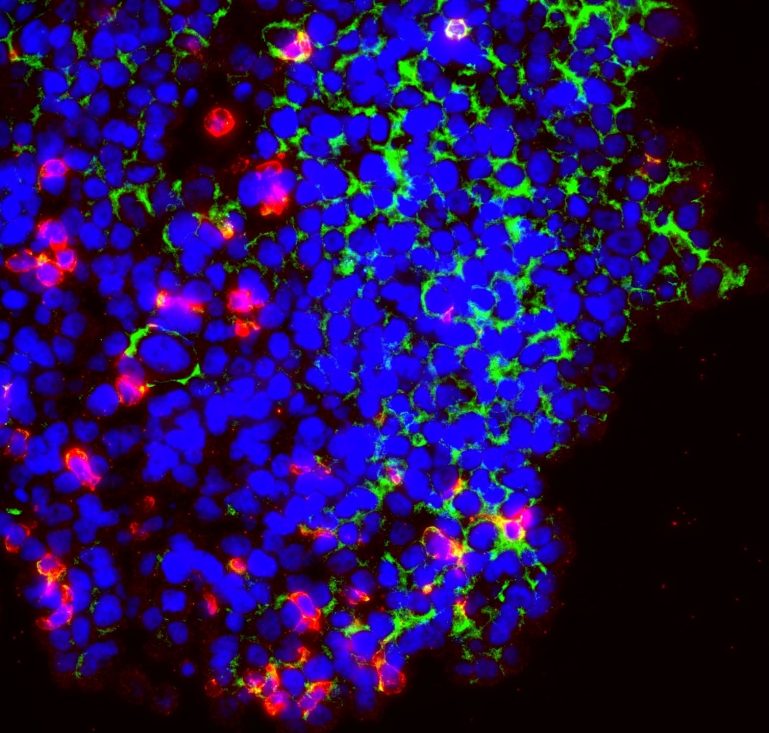
Guiding immune cells into tumors
A Stanford team used genetic screens to equip cancer-killing cells with receptors that follow metabolic signals into tumors.
Read the article →An experimental guide to the measurement, the biological question, and the limits of interpretation.
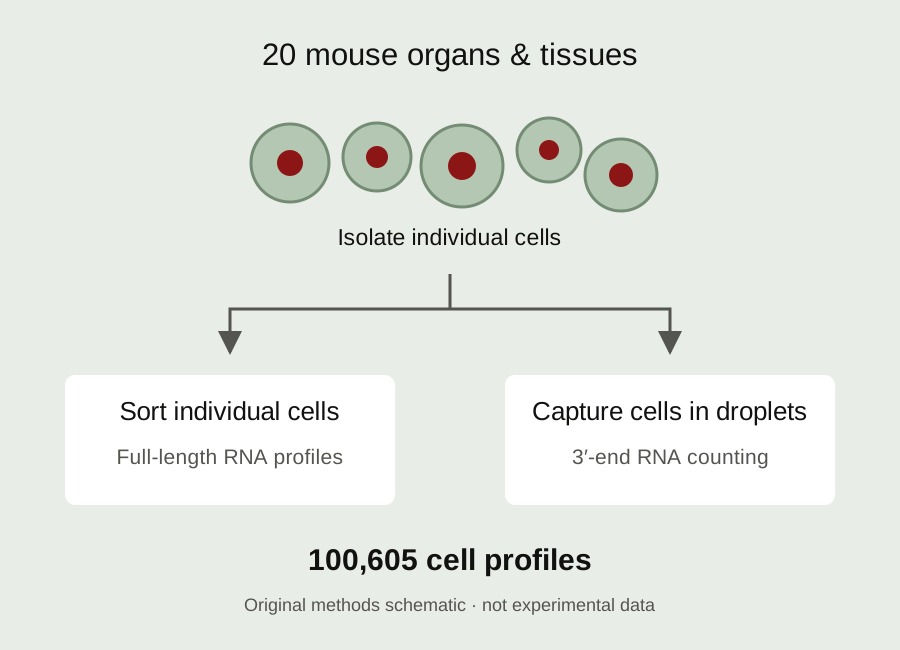
Single-cell RNA sequencing measures RNA from individual cells rather than averaging a whole tissue. Researchers separate cells, prepare their RNA for sequencing and use computational analysis to compare expression patterns. Cells with related patterns can be grouped, then interpreted using known markers and experimental context.
The method measures transcript abundance, offering evidence about cellular identity and state. In Tabula Muris, complementary sorting-based and droplet-based approaches surveyed cells across mouse tissues. The resulting reference supports comparisons between organs and can help researchers select genes or populations for follow-up experiments. It does not directly measure every protein or establish what a gene does.
A useful experiment starts by defining the cells and conditions being compared. A difference between healthy and diseased samples may reflect a change within a cell type, a change in the proportions of cell types, or both. Sampling multiple independent biological specimens is important because many cells from one specimen do not represent many independent organisms.
Tissue is dissociated, individual cells or nuclei are captured, and RNA molecules are converted into sequencing libraries. Computational processing assigns reads to genes and cells. Quality control removes poorly measured cells and considers artifacts such as two cells captured together. The resulting table records counts for genes across cells; the biological interpretation comes after those measurements.
Clusters summarize similarities in measured RNA profiles. They are interpreted using markers, experimental context, and other evidence. A cluster can suggest an unfamiliar cell state, but its appearance on a two-dimensional plot is not proof that it is a new biological cell type. Expression changes are useful leads for experiments that manipulate a candidate mechanism.
Tissue preparation can favor some cell types, and isolating cells removes their original spatial context. RNA abundance alone does not establish function.
A Stanford team used genetic screens to equip cancer-killing cells with receptors that follow metabolic signals into tumors.
Read the article →
SDR-seq pairs targeted genomic sequencing with RNA measurements in the same cells, helping connect precise variants to cellular behavior.
Read the article →
Genetic mapping, single-cell RNA sequencing and cell experiments connect an X-linked deletion to a pigment-cell signaling switch.
Read the article →