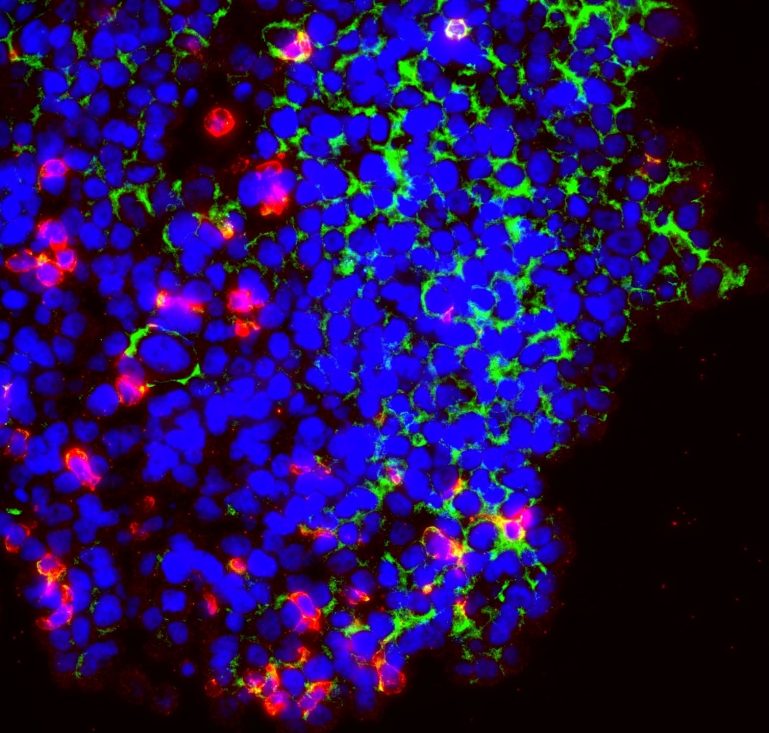
Single-cell method development with engineered stem cells and primary human lymphoma samples
Paper published 2025-09-01The missing link between genotype and cell state
Sequencing a cell’s RNA reveals which genes are active, but it does not reliably reveal every DNA change that might explain that activity. Some relevant variants sit outside genes, while a gene carrying a mutation may not be expressed when the cell is sampled. Dominik Lindenhofer and collaborators developed SDR-seq to connect these layers directly: measure selected genomic sites and selected RNA molecules in the same individual cells.
The study was led through EMBL with an international team that includes Stanford-affiliated corresponding author Lars Steinmetz. Its central problem is experimental rather than merely computational. If DNA is measured in one collection of cells and RNA in another, researchers must infer which genetic subpopulation produced a particular expression pattern. Measuring both in the same cell reduces that ambiguity, particularly in tumors where neighboring cells can carry different mutations.
How SDR-seq joins two measurements
SDR-seq uses targeted molecular panels and droplet-based processing. RNA is converted to complementary DNA while cells are still individually preserved, and subsequent amplification reads selected RNA-derived sequences together with genomic DNA sites. Molecular labels keep measurements associated with their originating cell. The investigators tested panels containing up to 480 combined DNA and RNA targets. These are selected targets across both modalities, not 480 whole genomes or a complete transcriptome.
The method’s precision matters because human cells generally carry two copies of most genomic regions. Missing one copy can make a genuinely heterozygous site look homozygous, a problem called allelic dropout. In well-covered tested targets, SDR-seq recovered heterozygous variants accurately in most cells. The team also mixed human and mouse cells to examine cross-contamination, used different panel sizes and compared gene-expression measurements with other datasets. Such checks assess whether a genotype-to-expression link reflects biology or a measurement artifact.
Testing edited cells and patient samples
In human induced pluripotent stem cells, the researchers combined the assay with CRISPR interference and precise editing strategies. An informative result was that suppressing a region with CRISPR interference could change gene expression even when installing a specific nearby variant did not establish the same effect. A broad perturbation and a one-letter substitution are different experiments. Prime-editing efficiency was also limited for many targets, leaving some variant effects unresolved rather than demonstrating that those variants had no biological function.
The team then examined primary B-cell lymphoma samples, pairing mutations with expression states within individual cells. Cells carrying a higher burden of the assayed mutations showed stronger B-cell-receptor signaling and tumor-associated expression programs. The paired measurements also helped distinguish malignant from other cells and investigate clonal structure. These observations connect genetic heterogeneity with cell state, but they do not prove that simply accumulating mutations causes every expression difference or predicts an individual patient’s treatment response.
The trade-off: depth versus breadth
The targeted design is both the method’s advantage and its limit. Concentrating sequencing on chosen sites improves depth and makes it easier to call variants, including ones in noncoding DNA. It also means that unselected genes and unexpected mutations are not comprehensively surveyed. Low-expression targets remain harder to detect, editing can generate too few informative cells, and a cell’s RNA profile is only a snapshot of its activity. The assay does not directly measure every protein or regulatory modification.
Future experiments could expand RNA panels, add other molecular layers or use mitochondrial variants to study lineage relationships. Each extension would need its own validation. For now, SDR-seq offers a practical route to a more specific question than simply asking which cells look different: among cells whose DNA states are directly observed, which expression changes accompany a particular variant? That connection makes functional follow-up more focused while preserving the distinction between a measured association and an established mechanism.
Key terms
- Genotype
- The DNA sequence or variant combination carried by a cell or organism.
- Transcriptome
- The collection of RNA molecules produced in a cell; SDR-seq measures a selected panel rather than the entire transcriptome.
- Allelic dropout
- Failure to detect one version of a genomic site, potentially making a cell appear to carry only the other version.
- Zygosity
- Whether the copies of a DNA site carry the same or different variants.
- Multiomics
- Measurement of more than one molecular layer, such as DNA and RNA, in a coordinated experiment.
Original publication
Lindenhofer, D. et al. Functional phenotyping of genomic variants using joint multiomic single-cell DNA–RNA sequencing. Nature Methods 22, 2032–2041 (2025).
September 2025
Read the paper · DOI 10.1038/s41592-025-02805-0 ↗Stanford profile and publication record ↗
Sources reviewed & Stanford connection
Full open-access primary paper, including experimental results, discussion and methods, plus official Stanford affiliation/publication record. This is not described as a Stanford-only study or a clinical validation trial.
EMBL-led collaborative study; corresponding author Lars Steinmetz also holds Stanford Department of Genetics and Stanford Genome Technology Center affiliations. Stanford affiliation is confirmed by the primary paper and official Stanford profile.
This is an original explanatory article about the cited study. It is not a new paper or Stanford-authored news report.