Preclinical laboratory study
Paper published 2025-05-21The biological question
A neuron faces a logistical problem as well as a genetic one. Its distant processes need proteins, and an RNA message made near the nucleus may need to travel a long way before it can be useful. Researchers in Stanley Qi’s Stanford laboratory asked how to manipulate that destination directly. Their 2025 study introduced CRISPR-mediated transcriptome organization, or CRISPR-TO, to test what happens when particular RNA molecules are moved to selected locations inside living cells.
How the experiments worked
The system repurposes Cas13, which normally targets RNA, into a binding tool with its cutting activity disabled. Guide RNAs specify the message to capture. An inducible molecular coupling then connects the bound RNA to either a cellular address or a motor protein. This design lets researchers recruit existing cellular RNA to a compartment or transport it along microtubules, without first editing a special repeated tag into every endogenous target RNA.
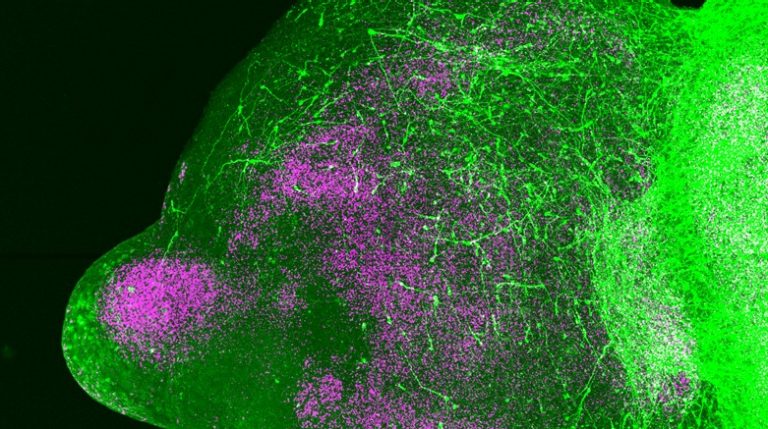
The team tested several destinations and cell types. Targets included the outer mitochondrial membrane, RNA-containing cellular bodies, nuclear locations, and the ends of neuronal processes. Imaging measured where RNA accumulated, and appropriate non-targeting and inducer controls helped distinguish specific transport from movement of the delivery machinery alone. In primary mouse cortical neurons, the researchers could move selected messages along neurites and toward their tips, including simultaneous targeting of more than one RNA.
What the researchers found
An important next question was whether a delivered message could actually make protein locally. A photoconvertible reporter allowed pre-existing protein to be distinguished from newly appearing protein near neurite tips. Translation inhibitors blocked the recovery attributed to protein synthesis. Additional imaging placed endogenous RNA near ribosomes and active translation signals. Together these experiments supported local translation of repositioned messages, while showing that only a subset of transported RNA was actively translating at a given time.
The biological outcome depended on which message was moved. Recruiting beta-actin RNA to neurite tips increased dynamic protrusions, yet in a microfluidic axonal-injury assay the same targeting inhibited axonal regeneration. The researchers also screened 21 candidate messages for effects on neurite outgrowth. Stmn2, which encodes the microtubule-associated protein stathmin-2, emerged as a candidate whose relocation toward neurite tips promoted outgrowth. These experiments make a useful distinction: more protrusions, longer neurites, and regeneration after injury are related but different measurements.
Why the biology matters
The study’s significance is that RNA position becomes an experimental variable. A sequencing experiment can show that a message exists, and an image can show where it sits, but neither observation alone proves what its location does. Programmable relocation helps test that relationship. The contrasting effects of beta-actin and Stmn2 argue against a simple rule that delivering any growth-related RNA to a neuronal tip will improve repair. Location, target identity, and biological context all matter.
Limits and unanswered questions
This is a platform-development and cell-biology study, with the neuronal experiments performed in cultured mouse cortical neurons. It did not demonstrate restored function after a spinal injury in a person or an animal, nor did it establish treatment efficacy for ALS or spinal muscular atrophy. Initial cell-culture checks of viability and stress do not substitute for delivery, immune-response, dosing, and safety studies in intact tissue. Guide design, RNA abundance, and the properties of different Cas proteins also affected performance.
Further work needs to determine whether useful RNA transport can be achieved in mature neurons within complex tissue, and whether changing one message’s position disturbs other processes over time. Human neurons and disease models can test how broadly the findings transfer. The immediate contribution is a way to ask causal questions about intracellular RNA geography. A future regenerative therapy would require a much longer evidence chain, from reliable local transport to sustained functional recovery and acceptable safety.
Key terms
- Spatial transcriptome
- The distribution of RNA molecules across locations within a cell or tissue.
- dCas13
- A Cas13 protein engineered to bind RNA without cutting it.
- Local translation
- Protein synthesis close to where an RNA message is located, including distant neuronal processes.
Original publication
Han, M. et al. Programmable control of spatial transcriptome in live cells and neurons. Nature 643, 241–251 (2025).
Published online 2025-05-21.
Read the paper · DOI 10.1038/s41586-025-09020-z ↗Read the peer-reviewed paper ↗
Sources reviewed & Stanford connection
Accessible PMC author manuscript main results read; Nature publisher abstract checked. Official Stanford Report confirms Stanford authorship. PMC availability date is 2026-02-08; paper publication date is 2025-05-21.
This is an original explanatory article about the cited study. It is not a new paper or Stanford-authored news report.