Functional genomics in primary human cells, with cancer-cell and tumor-growth follow-up
Paper published 2025-02-17The question: moving beyond association
A cancer-risk association is a starting point for biology, not a complete explanation. People who inherit a particular DNA variant may develop a cancer more often, but that variant could simply travel with the causal sequence nearby. Even a genuinely functional variant may act through a distant gene rather than the closest one. Laura Kellman, Paul Khavari and colleagues asked how to turn these statistical signposts into experimentally testable mechanisms across common cancers.
The team concentrated on inherited variation in regulatory DNA. This differs from searching a tumor for mutations acquired during a person’s life. Regulatory sequences can change how much of a protein a cell produces without changing the protein’s sequence. A small shift in gene activity, repeated over years or appearing under particular environmental conditions, could contribute to susceptibility without guaranteeing that cancer will develop.
How the experiment separates competing explanations
The researchers assembled 4,041 candidate variants associated with 13 cancer categories and tested the two versions of each sequence in relevant primary human cell types. Their massively parallel reporter assay attached short DNA fragments to a minimal promoter and a barcoded reporter. Sequencing the resulting RNA let them compare regulatory activity at scale. Matched versions differed at the candidate DNA letter, helping isolate a sequence-dependent effect from unrelated differences between people.
The screen identified 380 variants with different regulatory activity in a cell type relevant to the associated cancer. The authors then combined the reporter measurements with chromatin accessibility, DNA-contact maps and gene-expression association data to nominate possible target genes. The resulting networks included mitochondrial protein production, DNA-damage repair and Rho signaling. A separate CRISPR knockout screen asked whether some nominated genes were also needed by established cancer cells. That is a different question from whether an inherited variant initiates disease, and the distinction matters.
Following one variant into a mechanism
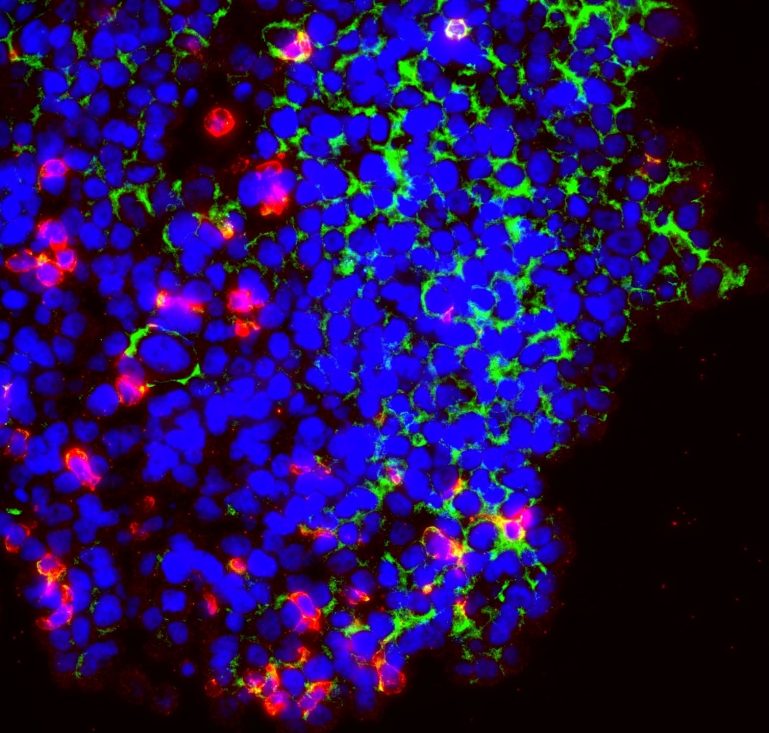
One colorectal-cancer-associated variant, rs10411210, received deeper experimental attention. Its risk-associated C version increased reporter activity, and the surrounding region contacted the RHPN2 promoter in primary colon cells. Suppressing the regulatory region reduced RHPN2 expression. The investigators then edited the DNA letter in otherwise matched primary colon-cell populations, moving beyond an isolated reporter fragment to the variant’s normal genomic setting.
Cells enriched for the risk-associated version expressed more RHPN2 and showed stronger RhoA activation after stimulation. This provides a plausible chain from DNA sequence to gene regulation to pathway behavior. It does not mean that every cell with this variant becomes malignant, or that inhibiting RHPN2 would safely prevent cancer. The value of the experiment is the mechanistic bridge: a common inherited difference can measurably alter a cancer-relevant cellular response.
What the findings do—and do not—establish
The paper is deliberately cautious about its larger catalog. Reporter assays place short sequences in a synthetic context and cannot reproduce every feature of a chromosome or living tissue. Candidate target-gene assignments can be wrong, especially when based partly on proximity or incomplete contact data. Cell culture also misses developmental history, inflammatory signals, aging and tissue architecture. Conversely, a variant with no effect in this screen could matter under conditions the experiment did not include.
The next task is to test more candidate variants at their endogenous locations, in additional donors and biological settings. Researchers also need to establish which effects combine, which are tissue-specific and which meaningfully improve risk prediction. This study supplies a functional prioritization resource rather than a finished genetic screening test. Its broader lesson is methodological: association, regulatory activity, target-gene assignment and disease causation require different evidence, and stronger explanations connect them experimentally.
Key terms
- Germline variant
- A DNA difference inherited through the egg or sperm, rather than acquired only within a tumor.
- GWAS
- A genome-wide association study that links DNA variants to a trait statistically, without by itself establishing a biological mechanism.
- MPRA
- A massively parallel reporter assay that compares the gene-regulatory activity of many DNA sequences using molecular barcodes.
- Noncoding DNA
- DNA that does not encode a protein; some noncoding sequences control when and where genes are expressed.
- RhoA
- A small signaling protein that helps regulate cell shape, movement and other cellular processes.
Original publication
Kellman, L. N. et al. Functional analysis of cancer-associated germline risk variants. Nature Genetics 57, 718–728 (2025).
February 2025
Read the paper · DOI 10.1038/s41588-024-02070-5 ↗Stanford Medicine research coverage ↗
Sources reviewed & Stanford connection
Full primary-paper author manuscript, including results, discussion and methods, plus official Stanford Medicine coverage. Experimental findings are distinguished from candidate mechanisms and possible clinical applications.
Stanford Medicine study led by Laura Kellman and senior author Paul Khavari, with Stanford Genetics collaborators.
This is an original explanatory article about the cited study. It is not a new paper or Stanford-authored news report.